From Cold to Closed: A B2B Lead Generation Playbook for 2026
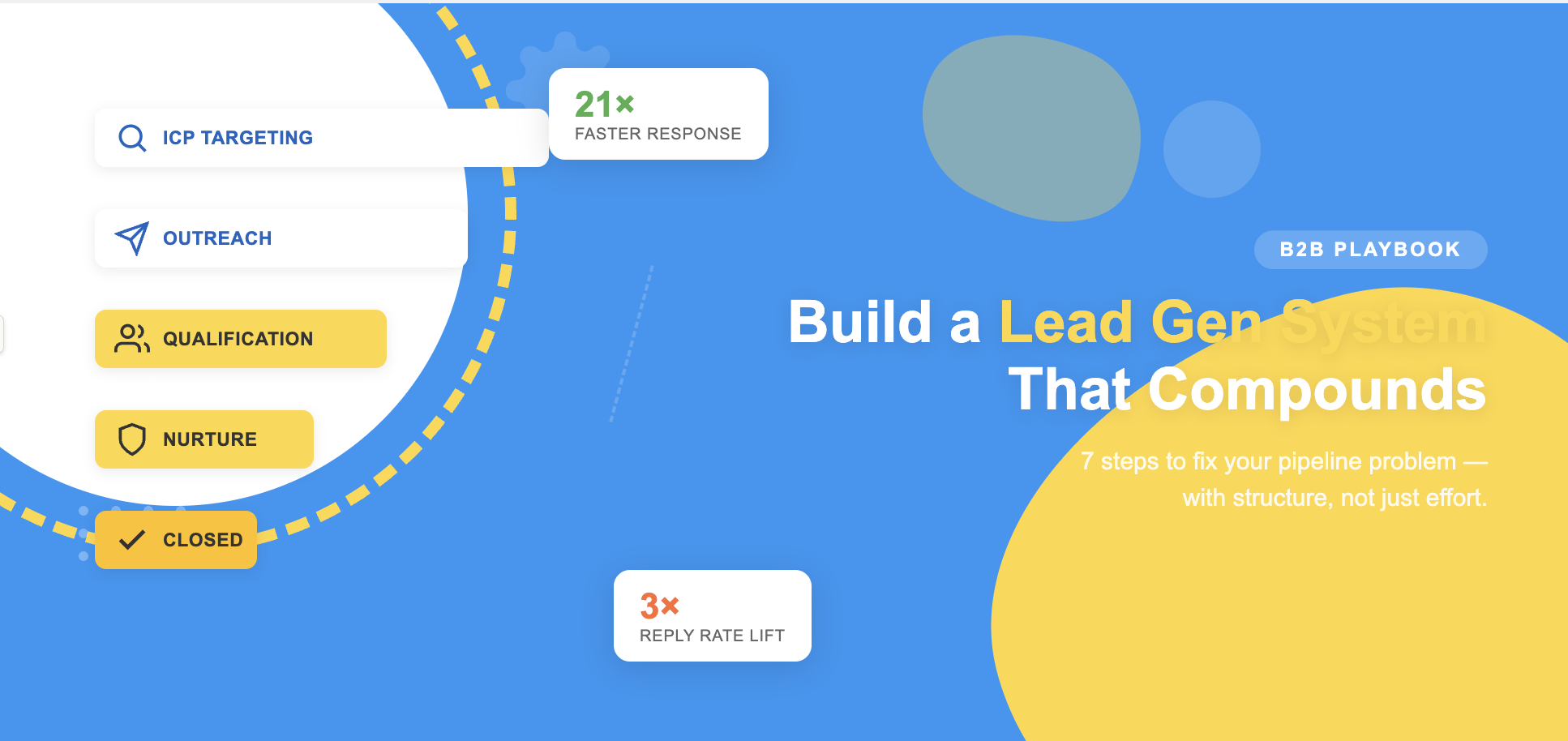
B2B Lead Generation: Your Pipeline Problem Is Not an Effort Problem
When pipeline is weak, the instinct is to work harder. Send more emails. Make more calls. Hire more SDRs.
But most B2B lead generation problems are not effort problems. They are structural ones. The process for finding buyers, reaching them, and converting them is broken at a fundamental level and adding volume to a broken process just produces more waste faster.
What a Broken Pipeline Looks Like
You have probably seen the symptoms before:
- The forecast is off by 40% at the end of every quarter.
- Reps grind through hundreds of touches and generate almost no replies.
- Deals that do progress stall for months with no clear reason.
- Good leads go cold because nobody responded fast enough.
- The team works harder every cycle with less to show for it.
The fix is not more effort. It is a system a deliberate, intent-driven B2B lead generation process that identifies the right companies at the right moment, reaches them in a way that feels relevant rather than random, qualifies quickly, and nurtures the rest until they are ready.
This playbook covers every step of that system.
Step 1: Build Your ICP With Data, Not Assumptions
An Ideal Customer Profile that lives in a slide deck is not a strategy. It is a hypothesis. A real ICP is built from data collected from the best customers you already have, and updated every quarter as more evidence comes in.
Start with your last 20 to 30 best accounts the ones that closed fastest, renewed at the highest rates, and generated the most expansion revenue. Then look at what they share across four dimensions:
- Firmographics: Which industries, headcount ranges, and revenue bands appear consistently?
- Technographics: Which tools are they using that signal they have the problem your product solves?
- Organizational indicators: Which job titles or team functions tend to be active in the accounts that close?
- Negative criteria: Which companies look like a perfect fit on paper but consistently churn early, drain support resources, or take forever to buy?
Knowing who not to target is just as valuable as knowing who to target. Share the ICP across sales and marketing, anchor every outreach decision to it, and review it quarterly with fresh closed-deal data.
Your ICP is the foundation of every B2B lead generation decision you make. If it is built on assumptions instead of evidence, everything downstream suffers.
Step 2: Use Intent Data to Find Buyers at the Right Moment
Demographic fit gets you in the right zip code. Intent data gets you to the right door at the right time.
A company that matches your ICP firmographically might be a great prospect in nine months. But a company that matches your ICP and shows active buying signals? That is a prospect to contact today.
What do those signals look like?
- They have visited your pricing page multiple times this week.
- Their employees are actively researching your category on review sites.
- They just posted a job listing for a role that signals near-term buying readiness (like a Sales Operations Manager).
Intent platforms like 6sense and Bombora aggregate behavioral signals from across the web to surface companies in active buying cycles. Website visitor identification tools show you which target accounts are already on your site, which pages they are visiting, and how often they return.
Layer these signals onto your ICP criteria and you get a prioritized list of accounts where timing is genuinely aligned.
Timing is the single most underrated variable in B2B lead generation. It is also the one with the highest individual impact on conversion rates.
Step 3: Personalize at the Contact Level, Not Just the Account Level
Volume-based outreach has effectively stopped working. Buyers receive more than 50 sales emails per week in 2026. They recognize and delete templated messages instantly.
The only outreach that earns replies is outreach that demonstrates specific, genuine knowledge of the recipient's current situation — not just their name and company.
This does not mean writing a completely custom email for every prospect. That does not scale. Instead, build a personalization framework: a core message structure that adapts quickly based on a few highly specific signals:
- What recent news is relevant to this company?
- What does their current tech stack reveal about where they feel friction?
- What do their job listings suggest they are trying to build?
- What has their team been engaging with on LinkedIn?
AI-powered research tools now automate much of this signal gathering, pulling context from company websites, LinkedIn profiles, news feeds, and CRM history to generate tailored opening lines at scale.
Teams using this approach consistently report 2–3x higher reply rates versus template-only outreach. That lift compounded across a full quarter is the difference between a B2B lead generation engine that builds and one that stalls.
Step 4: Run a Multi-Channel Sequence Built for Relevance
No single channel is enough to break through in 2026. Effective outbound sequences combine:
- 3–5 email touches over two to three weeks
- A LinkedIn connection or DM that references the email thread
- A phone call or short personalized video
- A content share that delivers genuine value regardless of whether the prospect ever buys
The principle that determines whether a sequence works is relevance over frequency. Three highly relevant touches will outperform seven generic ones every time.
Each touchpoint should earn the right to the next one by delivering something useful and specific: a relevant industry data point, a case study that mirrors the prospect's situation, or a question that shows you have done real research on their business.
When a prospect responds — even to say the timing is not right — move them out of the automated sequence immediately and into a real conversation. That signal changes the relationship and should be treated accordingly.
Step 5: Qualify Every Lead Immediately
Speed of response is one of the highest-leverage variables in B2B lead generation.
Leads engaged within five minutes of form submission are 21 times more likely to enter a real sales conversation than those contacted after 30 minutes. After 24 hours, the probability of meaningful engagement drops by more than 80%.
This creates a real capacity problem for teams relying entirely on human qualification — especially outside business hours or during high-inbound periods.
AI qualification agents solve this permanently. They can:
- Engage every inbound lead the moment they submit
- Gather qualification data conversationally
- Assess fit against ICP criteria in real time
- Route qualified leads to a rep instantly with a complete briefing
- Place lower-fit leads into an appropriate nurture sequence without manual triage
For outbound-sourced leads, qualification should happen early in the first discovery call. Use BANT or MEDDIC as your framework, but apply it conversationally. The goal is genuine mutual fit assessment — not gatekeeping.
Step 6: Nurture the 97% Who Are Not Ready Yet
Here is the number that changes how you think about generating B2B leads: only 3% of your addressable market is actively in a buying cycle at any given moment.
The other 97% fit your ICP perfectly but are not currently buying. Most organizations ignore this group completely until they show active intent signals. By that point, every competitor watching the same signals is reaching out at the same time.
The organizations with the deepest pipeline advantages are the ones that have been building relationships with that 97% for months or years before they enter a buying cycle.
An effective nurture program does not pitch. It delivers consistent, genuine value:
- Analysis that helps your ICP do their jobs better
- Frameworks they can apply immediately
- Honest perspectives on common mistakes in their space
The goal is to be the most trusted, most recognized voice in your category — so that when a company enters a buying cycle, your team is the first call they make, not one of ten unfamiliar vendors from a search result.
Step 7: Track Four B2B Lead Generation Metrics and Ignore the Rest
Most lead generation programs track too much and improve too little. Open rates, clicks, leads generated, and impressions are activity metrics. They tell you what happened. They do not tell you whether it mattered.
Track these four metrics instead:

Track all four weekly. Segment by channel and by rep. Build your improvement plan around whichever metric has the biggest gap from its target. The numbers will tell you exactly where to focus. All you have to do is pay attention to them consistently.
The B2B Lead Generation System That Gets Better With Every Cycle
The most valuable property of a well-built lead generation system is that it compounds over time.
Every qualified conversation produces better ICP data. Better data leads to more precise targeting. More precise targeting produces higher contact rates. Higher contact rates generate more qualified discussions, better forecasts, smarter resource allocation, and more closed revenue. More closed revenue produces richer customer data that sharpens the ICP further — and the whole loop tightens.
Teams that build this system deliberately and iterate every quarter accumulate structural advantages that ad hoc approaches cannot match.
The steps are not complicated:
- Define the ICP with real data.
- Build lists with intent signals.
- Personalize at the contact level.
- Run relevant multi-channel sequences.
- Qualify immediately.
- Nurture the long game.
- Measure four numbers and improve them.
The discipline to execute this consistently, month after month, is what separates teams that build pipeline from teams that chase it. That discipline is rarer than most sales leaders want to admit and more valuable than any single tactic in this playbook.
Join the B2B Sales Vuýp Webinar — learn the formula behind every high-performing B2B lead gen system: https://www.oplacrm.com/en/events-webinars/b2b-sales-vuyp


.png)
ISO CERTIFICATION


